Spotting and reporting fake reviews: what the law says and what you can do
You may already recognise gushing praise and a sudden flood of five-star reviews. But fake reviews are getting subtler. This article goes a step further: what does the law say, which signs are less well known, and where do you report a suspicious review?
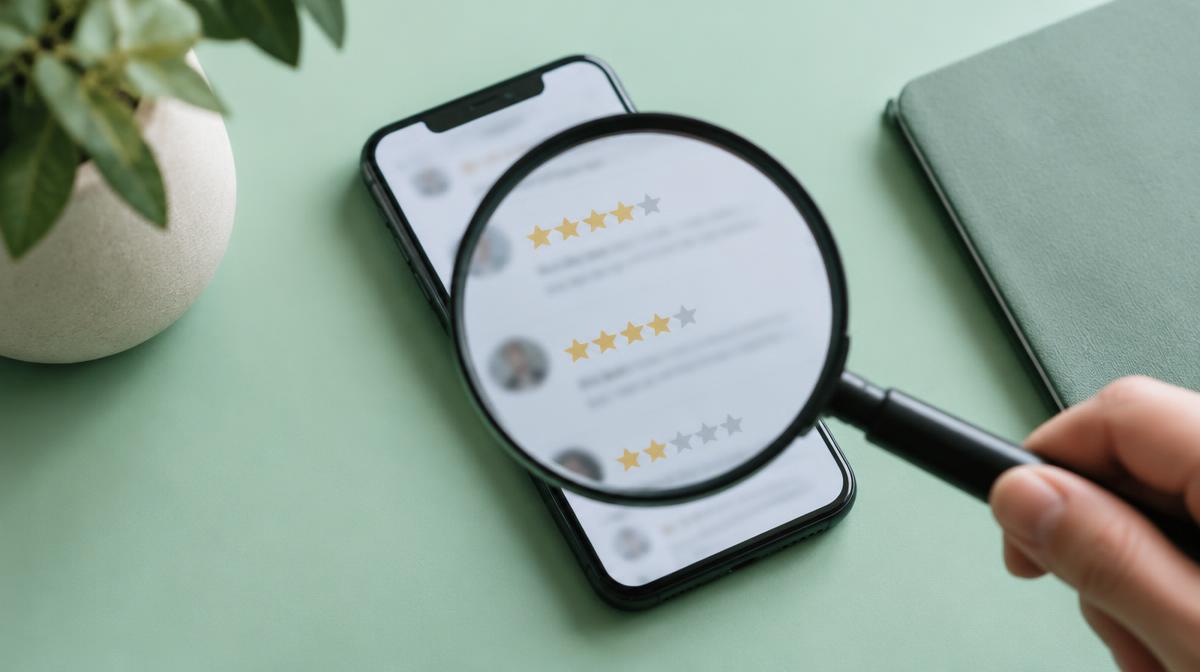
What the law prohibits
Since 28 May 2022, stricter rules on online reviews have applied in the EU through the Omnibus Directive. It is prohibited to post fake reviews, or to commission others to do so, in order to promote products. Misrepresenting genuine reviews is also prohibited, for example by showing only positive reviews and leaving out negative ones. The UK has since introduced its own ban on fake reviews too.
In addition, a business that shows reviews must state whether and how it checks that they come from real customers. It may not claim that reviews come from genuine buyers if it has not taken reasonable steps to verify this.
An incentivised review is not automatically prohibited, but readers must then be able to see that there was a reward. A bought review presented as an independent customer experience is misleading.
Having rules does not mean everyone follows them. In a 2022 European sweep of 223 major websites, authorities could not confirm for 144 of them that enough was being done to ensure reviews came from real users.
First look at the website’s explanation
Look near the reviews for a link such as ‘how we check reviews’. It should explain whether reviews are checked, who may write one and what happens to negative reviews. If that explanation is missing, or it only says that ‘all reviews are genuine’, you do not really know anything.
Pay attention to labels too. ‘Verified purchase’ means something different from ‘verified account’: an account can be genuine even though the writer never bought the product. On trustmark.site, purchase-linked and open reviews each get their own label, and every new review starts as ‘awaiting review’.
An online shop that collects and shows its own reviews has an interest in them being positive. That need not be a problem, as long as the process is transparent. With a review platform, you can check whether paying businesses can have reviews removed. At trustmark.site, payment never guarantees that a review disappears.
Less obvious signs of fake reviews
No single sign is proof on its own. A new reviewer or one short review can be perfectly genuine. So look at the pattern and at several sources, and watch for these signs that only show up when you look more closely:
- Reviews about a different product, for example because reviews of several products have been merged on one page
- Lots of reviews that mostly repeat the brand name but say little about actually using it
- The same phrases or structure from different reviewers, or across different shops
- Reviewers who write glowing reviews of businesses in very different places and sectors within a short time
- A wave of positive reviews right after a run of critical ones
- Mentions like ‘received a free product’ without the website clearly labelling it
- Reviews that mainly run down a competitor instead of describing an actual experience
AI-written text and the bigger picture
Text written with AI is hard to recognise, and real customers sometimes use writing help too. So do not rely on so-called AI detectors, but on concrete details you can check: the delivery time, the product variant, the contact with customer service.
Check whether a business gives a similar picture across different platforms. An online shop with nothing but five stars on its own site and lots of complaints elsewhere deserves a second look. Read the three-star reviews too: they are often the most informative. And a score of exactly 5.0 across hundreds of reviews is unusual; real groups of customers almost always include someone who was less satisfied.
Still in doubt? Ask the business a question, or ask people you know about their experiences. The more independent sources say the same thing, the more reliable the picture.
How to report a suspicious review
On almost every platform you can report a review. Use that button and give a specific reason, such as ‘this review is about a different product’ or ‘the same text appears for another shop’. A report with examples is easier to assess than just ‘this is fake’.
Under the Digital Services Act, online platforms in the EU must offer an easy way to report illegal content and tell the person reporting it what they did with the report. So keep a copy or screenshot of your report.
Do you suspect a business is systematically buying or inventing reviews? In the Netherlands, report it to ACM ConsuWijzer; elsewhere, contact your national consumer authority. The ACM does not resolve individual complaints, but it uses reports to decide where to investigate, and it has previously taken action against sellers of fake reviews and their customers.
If you see a suspicious review on trustmark.site, report it via our contact page with a link to the review and your reason. We assess reports against our terms. A negative rating on its own is not a reason to remove a review.
How to read reviews smartly in five minutes
You do not need to be a detective. With these habits you can surface the useful experiences in a few minutes:
- Sort by newest and read the latest ten reviews
- Read the critical and middling reviews as well as the best ones
- See how the business responds to complaints
- Look for photos and details you can check
- Compare the score with at least one other platform
- Find out exactly what labels such as ‘verified purchase’ mean
More about shoppers

Is a website legit? How to check an online shop in 5 minutes
An online shop check in five steps: domain name, the Dutch police trader check, business register, trustmark, reviews and payment method. Plus what a check does not tell you and what to do if things go wrong.
· 5 min read
Are Temu, Shein and AliExpress trustworthy? How to check for yourself
Temu, Shein and AliExpress are not fake shops, but they are platforms with their own risks. How to check the seller, product safety, costs and return rights, with the latest EU decisions summarised.
· 5 min read
Spotting scams on Marktplaats: 6 tricks and what to do next
The best-known scams on the Dutch classifieds site Marktplaats, from the one-cent payment request to the fake courier. Plus how to check a buyer or seller and what to do straight away if you have been scammed.
· 5 min read